Some things you should know about the HP 8640B
Things to Look for Before Purchasing an 8640B
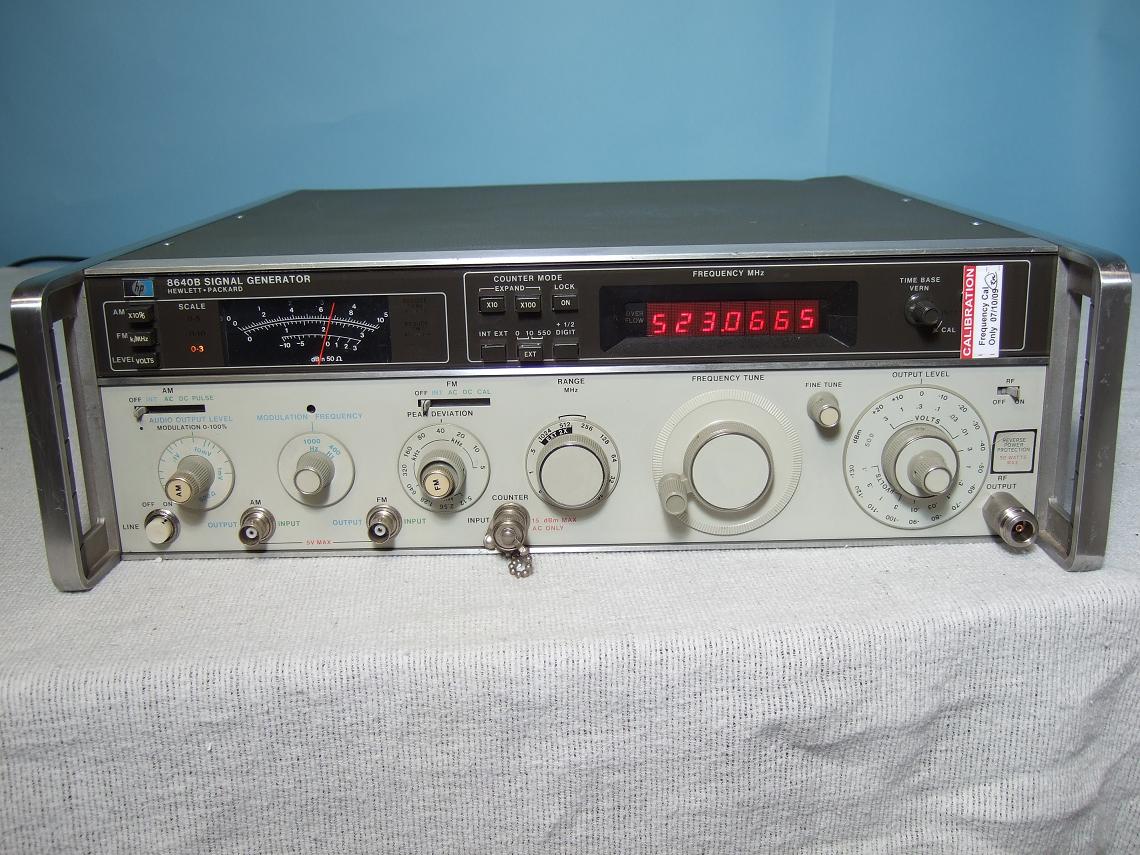
If you’re considering a purchase from a marketplace like eBay, look closely at the unit's front panel. All 8640B models have the ability to select internal or external AM or FM modulation. The switches for this selection are located near the left-middle of the unit. Look closely at the pictures. These switches as well as the RF power on/off switch on the far right are weak points in the 8640B design. The small lever arms of these switches break easily if the unit is dropped or abused. If you can't see the small paddle arm of the switch, then it is likely broken and you won't be able to fix it without extensive removal of internal components. If the arm is intact, it will likely remain so. It is only broken through rough handling. Likewise, look closely at all the remaining controls and inspect pictures for cracked or missing control knobs.
If a picture of the rear panel is available, note if the two plastic rear feet are visible on the right side of the unit. It is not uncommon for one or both of these to be broken off. They are located just to the left of the power port connection. This is not a problem if you are using this as a bench unit. The rear feet only help stabilize the unit if it is tipped up on its back end. There may be up to five of these plastic feet on the bottom of the unit. Again, not a critical point if they are missing. These feet are designed so that you can stack HP equipment one on top of the other.
We generally remove the feet on any HP equipment we have in house because they mostly tend to get in the way. The only advantage that we have found with the feet is that some units come with a tilt stand in the front that attaches to the front two feet—a nice feature if you don't have a test equipment bench or shelving in front of you on which to rest the unit.
Other trouble spots are the several incandescent bulbs on either side of the power meter that indicate the meter scale (left side) and various over-range conditions (right side). It is not unusual for one or more of these bulbs to burn out. You really can't tell from a picture if the bulb has failed because they only illuminate under the correct conditions. When we refurbish a unit, we will replace these bulbs with bulbs that have a slightly higher voltage rating to ensure long life. Make sure that potential sellers have tested all six bulbs.
The 8640B uses a mechanically tuned cavity oscillator to set a very stable frequency output. The tuning assembly sits directly behind the tuning knob. If the inside of this assembly is dirty or contaminated, the unit may drop out of oscillation, usually at one end or the other of the limit stops. Ask the seller to guarantee the frequency adjustment knob operates over its entire range. Complete tuning across the entire selected band is accomplished with about eight turns of the tuning knob. There is a fine-tuning adjustment just to the right of the main knob that adjusts to 200 ppm. Restabilization time after tuning is very short, about 15 minutes for better than 20 ppm. There is also a phase-lock button that will lock in the frequency and also allow for a half-scale extension of accuracy (one half of the least significant digit). Note: There are several failure modes associated with the fine-tuning knob; ask the seller if the fine-tuning knob works correctly.
Many of these units have minor dents and dings in their cases; this is usually not a problem. HP designed these units well, and they are fairly robust mechanically despite such cosmetic concerns.
It is always best if you can spot a picture where the unit is turned on and both the frequency meter and the analog meter are displaying properly. Ideally, the analog meter should be set to display the output power; however, it may be difficult to discern if the output button is depressed rather than the modulation buttons (one meter, three selector switches). The frequency display on the 8640B is a standalone frequency counter that can send a phase lock signal back to the oscillator. If the digital display is showing a value that corresponds to the frequency range selector, then the oscillator is operating and the range selector switch is probably operating too. If the meter displays a value while it is set to read power output, you are now assured that the basic operation of the oscillator, frequency counter, and power output stages are good. What remains are the AM and FM modulation sections, and a reputable seller will guarantee and perhaps offer a warranty on the unit. (Warranties are available on almost everything we sell. If we don't offer a warranty, we will offer full disclosure.)
We have highlighted some of the weaknesses and strengths of this model. There are many other issues that are too numerous to list. Various versions of this signal generator were produced with slight nuances such as display resolution, half-digit display in phase-lock mode, changes in the knob design, internal changes in the selector switch designs, etc.
The 8640B is a durable and reliable piece of test equipment. Parts or equivalent substitutions are still available, and any problems are easily diagnosed down to the component level. There are many schematics and operations manuals available in the public domain. A well maintained 8640B should offer you a long and reliable life. Your best defense is to purchase from a good and established seller who can offer you at least a guarantee of functionality and perhaps a warranty on any unit you buy.
If you have any questions on the 8640B, please don't hesitate to contact us. Even if you're not purchasing from us, we are still more than willing to help you with tips and questions, where to locate documentation and parts, and anything else you may want to know.
All Information contained herein copyrighted (c) 2020
If you have any questions on the 8640B, please don't hesitate to contact us. Even if you're not purchasing from us, we are still more than willing to help you with tips and questions, where to locate documentation, parts, etc.